
COGNITIVE BEHAVIOUR THERAPY
Cognitive-behaviour therapy (CBT) is a cornerstone of treatment at Burlington Psychological and Counselling Services. It is a scientific, evidence-based psychotherapeutic approach that is considered “best practice” for many psychological issues. In a nutshell, CBT focuses on how your thinking influences your feelings and behaviours.
The ABCs of CBT
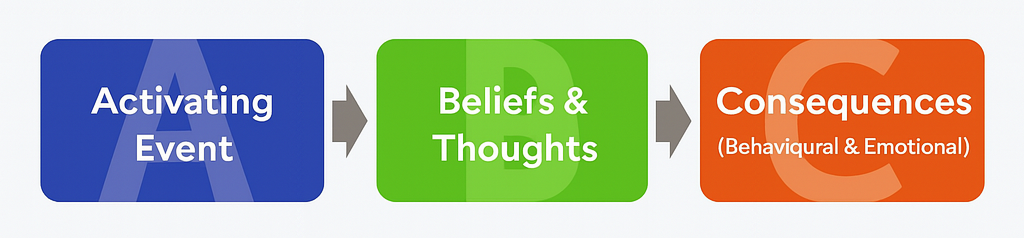
The primary idea is that it’s your thoughts about things that happen-not the events themselves – that cause you to feel or behave in a certain way. This relationship is often referred to as the ABCs of CBT, and whether you are reacting to a relationship ending, landing your dream job, or living with chronic pain or an illness, the process is essentially the same.
Changing the Way you Think
Again, it is not the things that happen to us that make us feel good or bad. It’s the messages we tell ourselves that determine how we feel. Fortunately, you can learn to change the way you think, and in doing so, change the way you feel. We’re not talking about just “thinking positively”—bad things do happen in life. Rather, it is about evaluating the evidence for your thoughts and then challenging their truthfulness or helpfulness.
In CBT, the first step in challenging your thinking is self-monitoring; that is, watching and becoming aware of how and what you think and the messages you routinely give yourself. This is often more difficult than one would expect. Our thoughts tend to be so automatic and routine that we’re not even aware of them. Usually, you can quickly identify the activating event and the emotional consequence—that is, you know what has happened and how you feel—but identifying the thoughts and beliefs that led to the emotional reaction can be more difficult. Once you are fully aware of your thoughts, you can then take the next step, which is to dispute your thoughts and replace them with more helpful and reasonable ones.
Changing Behaviour
Another goal of CBT is to address behaviours that may be contributing to and or perpetuating difficulties with coping. When we feel down or fearful, our natural reaction is to retreat, escape, or avoid. Although escape and avoidance may make us feel better in the short term, they do not solve the problem and often just make it that much more difficult to cope the next time around. In CBT, gradual behavioural steps are identified so that the coping strategies can be tested out in a step-by-step fashion.
Could CBT work for you?
Most people find that CBT has a very positive effect on their quality of life. CBT has been shown to be helpful in dealing with many problems, including worry, stress, panic, sadness and depression, OCD, eating disorders, anger, low self-esteem, difficulty adjusting, chronic pain, and lifestyle issues. CBT can also be used with children. There are several very good self-help CBT workbooks on the market, which you can find at your local bookstore. However, many people find that it is particularly helpful to work with someone who has been properly trained in CBT techniques. If you would like to get more information on CBT or the treatment services provided by our clinicians, please do not hesitate to contact us.
Mental Clarity
Helps you identify and shift negative thought patterns.
Emotional Resilience
Strengthens your ability to cope with life’s challenges.
Communication Skills
Improves your ability to express yourself clearly and effectively.
Confidence
Builds self-esteem and assertiveness through guided practice.