
Executive Function Training
At Burlington Psychological and Counselling Services, we are pleased to offer science-based executive functioning training for teens and young adults! Young people today face many pressures, from managing technology, keeping up with the demands of school, achieving the grades necessary to get into desired post-secondary programs, and becoming more independent at a time when the future may seem uncertain. We have heard from many of our young clients (and their parents) that they need some support to “get stuff done.” Executive functioning training does just that.

What are Executive Functions?
Executive Functions are a set of brain-based skills that help us to carry out tasks so we can get stuff done and work towards our larger goals.
Executive functioning is like having a great personal assistant in your head. It reminds you of your schedule, keeps track of your to-do list, stops you from sending that angry text, and helps you switch gears when plans change.
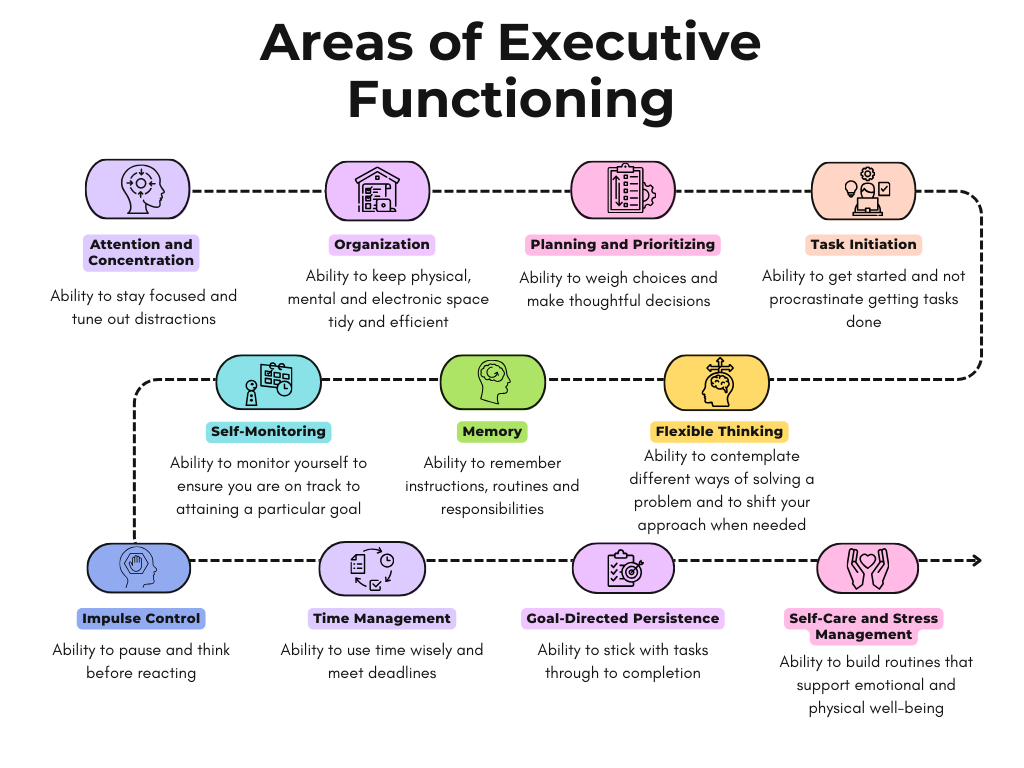
Executive functions include several different areas, as depicted below.
Although genetics influence an individual’s executive functioning, early environments and learning experiences play a crucial role in shaping an individual’s executive functioning toolbox. This is great news, as it means that executive functions can be taught and strengthened through practice! The human brain continues to develop right up until the mid- and even late 20s, so executive functioning training during adolescence and early adulthood can have long-lasting benefits.
Signs of executive function difficulty:
To be honest, we all struggle with executive functioning sometimes. We all tend to put off unenjoyable tasks and can get distracted by less important things, such as our phones or social media. However, for some individuals, executive functioning difficulties can significantly impact overall functioning and prevent them from reaching their full academic and/or vocational potential. For example, a student may have a great understanding of the course material but still get low to mediocre grades because of leaving assignments and studying to the last minute or forgetting to hand in work. Similarly, a skilled employee may get passed over for promotions because of consistently being late for work or failing to get tasks done in an efficient manner. Weak executive functioning can also have an impact on social relationships, as peers may become frustrated by what looks like unreliability. And it most definitely can impact the parent-child relationship! Parents of children, teens and young adults with executive functioning difficulties often feel like they must micromanage most aspects of their child’s life, including keeping track of all assignments, reminding them to study, urging them not to be late, and constantly nagging them to get down to work!


Here are some signs of executive function difficulties:
- Having great ideas but struggling to get them organized on paper.
- Understanding course material but not doing well on tests or assignments.
- Needing lots of reminders and prompts to get stuff done.
- Underestimating the amount of time a task will take.
- Struggling to organize one’s day or week.
- Forgetting deadlines or appointments.
- Leaving tasks to the last minute.
- Frequently arriving late to school, work, appointments, etc.
- Frequently misplacing belongings or failing to bring the necessary things.
- Difficulty prioritizing important tasks.
- Difficulty remembering instructions.
- Having a messy space.
What does Executive Function Training focus on?
Executive function training is all about helping older kids, teens, and young adults get better at the “mental tools” they need to manage everyday life. The goal is to make things like focusing, organizing, planning, and staying calm easier and more automatic. Think of it like going to the gym — but instead of lifting weights, you’re strengthening the brain’s ability to think ahead, stay on track, and handle challenges. You’re training the brain to be its own amazing personal assistant!
Here are some of the main goals of EF Training:
1. Getting Organized
Learning how to keep track of stuff, time, and tasks — like remembering homework, knowing where your worksheets and calculator are, or planning what to do first when you have a lot to do.
2. Staying Focused
Improving the ability to pay attention to what matters (like a conversation, a math problem, or reading instructions) and ignore distractions (like phones, noises, or wandering thoughts).
3. Following Through
Making it easier to start tasks, stick with them, and finish them — even when they’re boring or hard. It’s about building the “get-it-done” muscle!
4. Managing Emotions
Staying calm when frustrated or overwhelmed, and making thoughtful choices instead of reacting too quickly or avoiding a task/situation altogether.
5. Solving Problems and Adapting when Necessary
Building skills for thinking through problems, making plans, and adjusting when things don’t go as expected (like when your ride cancels or your original plan falls through).
6. Building Independence
Ultimately, the goal is to take charge of one’s own life — whether that means getting to work on time, handling school deadlines, or managing daily responsibilities without constant reminders.


What does EF Training look like?
With EF Training, an Education Specialist and Psychologist work together to support student success. This typically includes:
1) A comprehensive intake including parent and student interviews and questionnaires. The Education Specialist and Psychologist will also review any documents you have provided, including report cards, psychoeducational assessments, Individual Education Plans, relevant medical reports, etc.
2) Development of a personalized training program based on identified areas of need.
3) One-on-one virtual weekly or bi-weekly training sessions with the Education Specialist, with the focus being the student’s actual work expectations. For example, the Education Specialist will help the student to identify what assignments and tests they have coming up, develop a plan for the week, review progress on current and past goals, and track overall performance. EF Training is incorporated in each session, with the overall goal being to foster eventual independence.
*For families who are not sure if they want to commit to on-going EF Training, a few sessions to introduce some strategies to help improve executive functioning may be possible.
FAQs about EF Training:
Whereas tutoring targets specific academic content (e.g., math), EF Training teaches students how to be successful (e.g., how to study, how to manage their time, how to stay motivated, how to focus, etc.).
All students may benefit from EF Training, however, middle-school (Grade 7-8), high-school and university/college students are most likely to benefit. Students with ADHD, LDs, Anxiety, ASD, and other mental health conditions often find it particularly helpful. And parents like it as they no longer feel the need to act as the academic police!
EF Training falls under our Psychological Treatment Services, as the Psychologist collaborates with and supervises the Ontario Certified Teacher on all aspects of the training. Please check to see if your insurance provider covers services provided under the supervision of a Registered Psychologist.